Overview
The Multi-Agent Email Forensics System is an intelligent agent-based solution for automated security analysis of email communications. The system employs four specialized autonomous agents working in a coordinated pipeline to discover, analyze, visualize, and report on potential security threats.
Key Capabilities
- Automated Threat Detection: Identifies suspicious emails based on keywords, temporal patterns, source analysis, and volume anomalies
- Multi-Strategy Analysis: Employs four parallel detection strategies for comprehensive coverage
- Visual Analytics: Generates 8 different visualization types for pattern recognition
- Comprehensive Reporting: Produces both technical (text) and executive (HTML) reports
- Forensic Quality: Designed following digital forensics best practices (NIST SP 800-86)
System Architecture
The system implements a cooperative multi-agent architecture where four specialized agents work sequentially in a pipeline:
┌─────────────────┐     ┌──────────────┐     ┌─────────────────┐     ┌────────────────┐
│  Discovery      │────▶│  Analysis    │────▶│  Dashboard      │────▶│  Report        │
│  Agent          │     │  Agent       │     │  Agent          │     │  Agent         │
└─────────────────┘     └──────────────┘     └─────────────────┘     └────────────────┘
        │                       │                      │                       │
        ▼                       ▼                      ▼                       ▼
   Email Files            Findings List         Visualizations          Reports
1. DiscoveryAgent
Role: Autonomous data acquisition
Locates email files and parses them into structured objects
Pattern: Repository
2. AnalysisAgent
Role: Threat detection
Applies 4 parallel detection strategies
Pattern: Strategy
3. DashboardAgent
Role: Visual analytics
Creates 8 visualization types
Pattern: Factory
4. ReportAgent
Role: Report generation
Produces text and HTML reports
Pattern: Template Method
Analysis Results & Visualizations
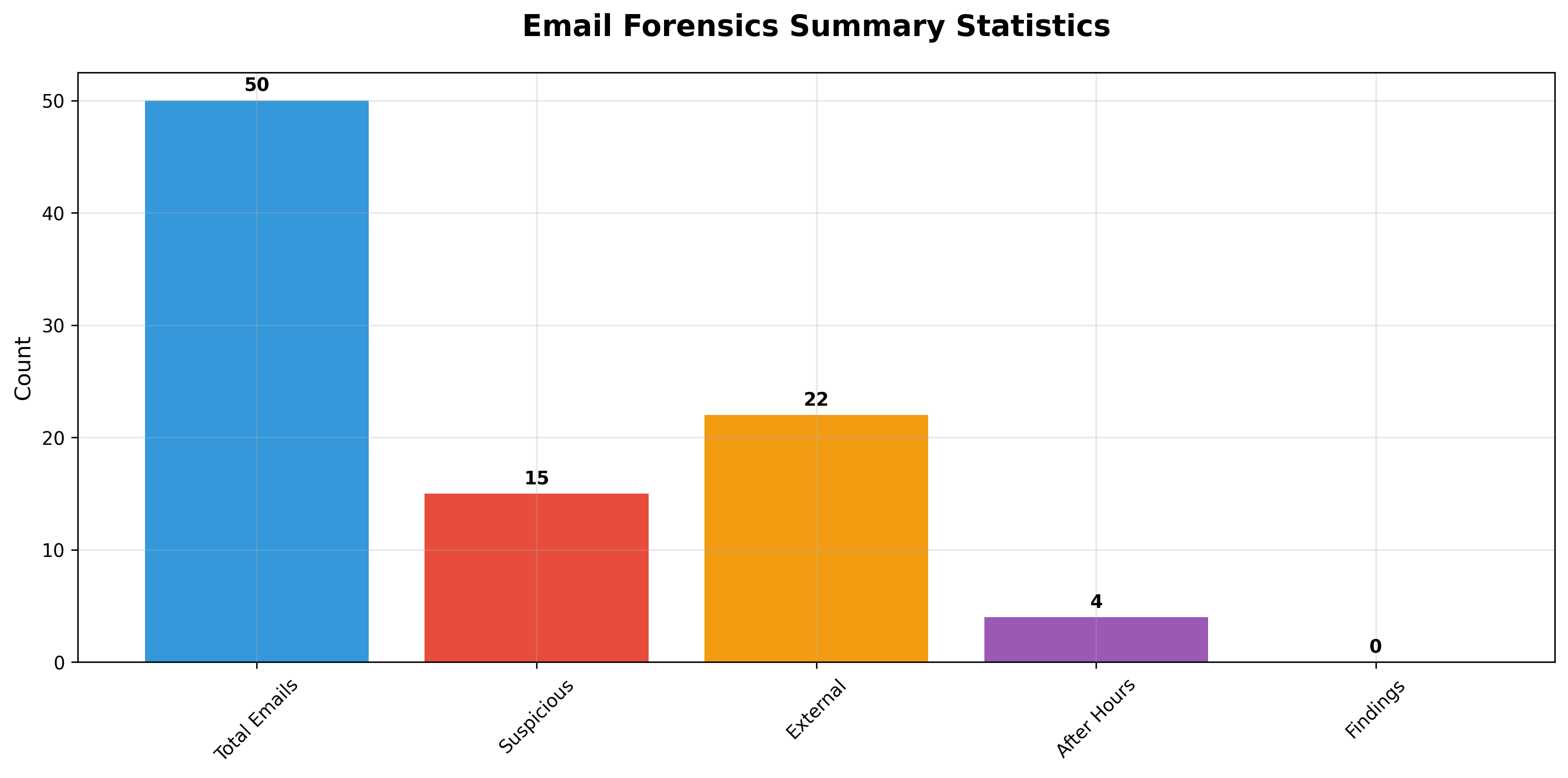
Summary Statistics
Key Visualizations


Six-Stage Pipeline
Stage 1: Data Generation
EnhancedEmailGenerator creates 50 test emails (30% suspicious, 70% normal) with realistic subjects, timestamps, and sender domains.
Output: Email files in output/emails/
Stage 2: Discovery
DiscoveryAgent autonomously locates and loads emails, parsing structure (ID, Subject, From, To, Date, Content) into SimpleEmail objects.
Output: List of SimpleEmail objects
Stage 3: Analysis
AnalysisAgent applies four parallel detection strategies:
- Keyword Analysis: Scans for 21 suspicious terms (urgent, confidential, bitcoin, phishing, etc.)
- Temporal Analysis: Flags after-hours emails (outside 8 AM - 6 PM)
- Source Analysis: Identifies external domain communications
- Volume Analysis: Detects anomalous sending patterns
Output: List of Finding objects with severity classification (High/Medium/Low)
Stage 4: Visualization
DashboardAgent generates 8 visualizations using matplotlib, seaborn, and wordcloud:
- Summary statistics chart
- Email distribution pie chart
- Hourly activity histogram
- Subject word cloud
- Activity timeline
- Day-hour heatmap
- Network analysis
- Severity distribution
Output: PNG files in output/visualizations/
Stage 5: Reporting
ReportAgent consolidates results using Jinja2 templates into text and HTML formats with embedded visualizations.
Output: forensics_report.html and forensics_report.txt in output/reports/
Stage 6: UML Documentation
Auto-generates PlantUML class and sequence diagrams documenting system architecture.
Output: Documentation in output/uml_documentation/
Technical Implementation
Data Models
SimpleEmail: Email dataclass with fields id, subject, sender, recipient, date, content, file_path
Methods:
is_suspicious()- Checks for 21 suspicious keywordsis_after_hours()- Detects outside business hours (8 AM - 6 PM)is_external()- Checks if sender is from external domain
Finding: Investigation finding with finding_type, description, email_id, severity, timestamp
Dependencies
- Data: pandas ≥1.5.0, numpy ≥1.23.0
- Visualization: matplotlib ≥3.6.0, seaborn ≥0.12.0, wordcloud ≥1.9.0
- Templating: jinja2 ≥3.1.0
- Testing: pytest ≥7.2.0, pytest-cov ≥4.0.0
Testing & Validation
29 tests, 100% passing:
- 25 unit tests (individual methods)
- 3 integration tests (agent coordination)
- 1 end-to-end test (complete pipeline)
Personal Reflection
Building this multi-agent system from scratch revealed the practical value of autonomous, specialized agents working in coordinated pipelines. The separation of concerns between discovery, analysis, visualization, and reporting made the system easier to develop, test, and maintain.
Implementing four detection strategies taught me that effective security analysis requires multiple perspectives. Keyword detection alone misses after-hours anomalies, while temporal analysis misses sophisticated phishing from normal hours. The comprehensive testing (29 tests, 100% passing) caught integration bugs early, particularly in data flow between agents.
This project connected theoretical concepts about agent architectures (Wooldridge, 2009) with practical concerns like error handling and user experience. Generating professional visualizations taught me that intelligent systems must present results in accessible formats for non-technical stakeholders.